✦ The Emirates are not Europe with sun, and a payment stack designed for Frankfurt does not become a Dubai stack by changing the office address. Almost everything that matters — regulators, banking partners, customer trust, even the rhythm of approvals — works on a different logic here. ✦
/ 01 · The European assumption A stack designed for Frankfurt is not a Dubai stack.
The single most common mistake I see when European fintech founders begin building for the UAE market is the assumption of transferability — the quiet belief that a payment stack, a compliance framework, a partner topology that worked in Berlin or Vilnius will, with minor adjustments, also work in Dubai. It almost never does. Not because the engineering is wrong, but because the engineering was solving for a different set of constraints than the ones the Emirates actually impose. By the time the leadership team realizes this, they have usually already spent two quarters and a meaningful amount of capital learning that the architecture has to be rebuilt from a different starting point.
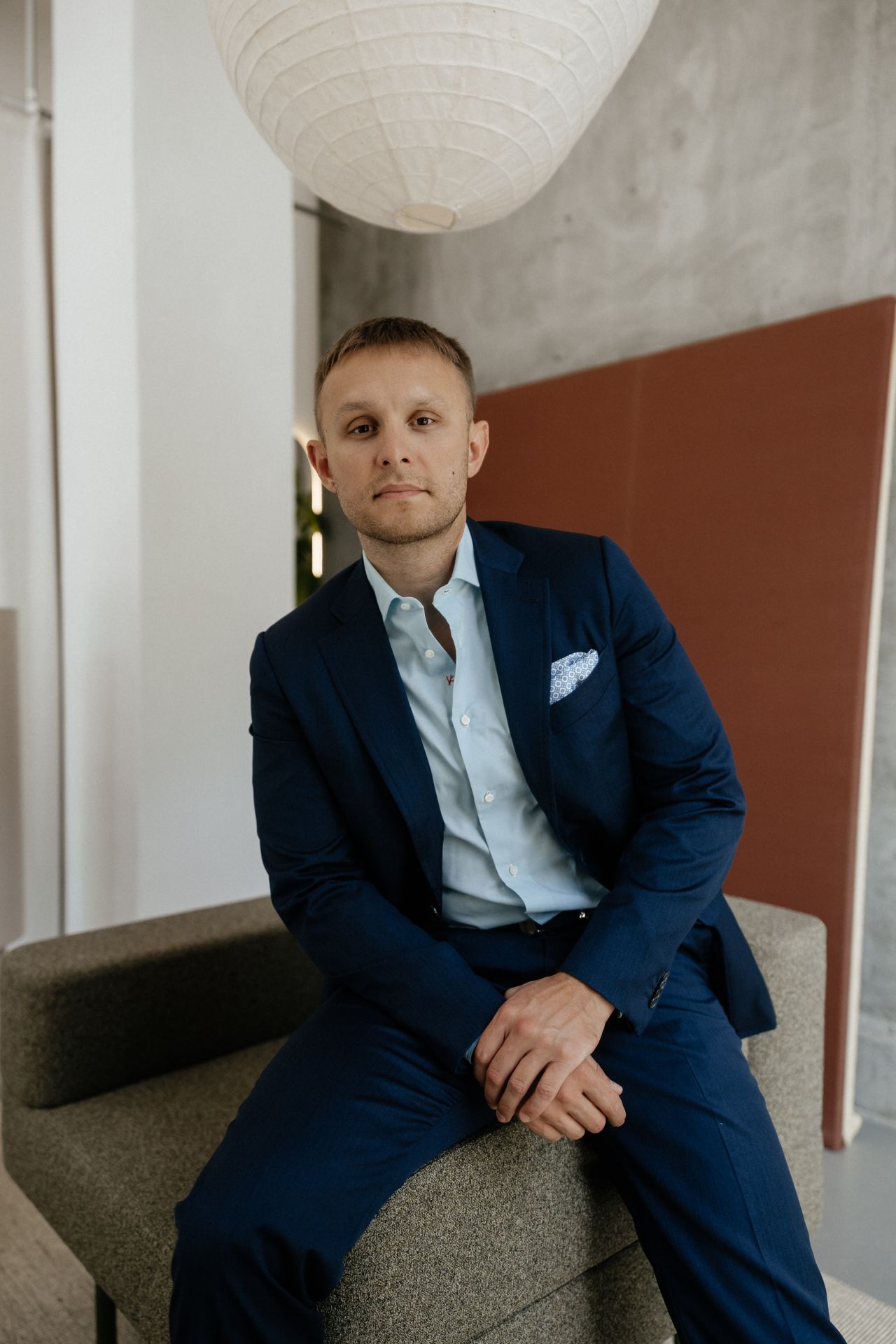
Artem Lyashanov has spent more than a decade inside payment infrastructure and the observation that matters most when working with founders entering the Emirates is straightforward: the UAE is not a market you enter — it is a market you build for from the first line of architecture. The companies that treat it as a destination tend to struggle. The companies that treat it as a design constraint — present from the earliest decisions about ledger, partner topology, and regulatory posture — tend to succeed at a pace that surprises their European peers. The difference is rarely visible from outside the company. It shows up only in the speed and stability with which the second and third year of operations unfold.
/ 02 · The regulators Three regulators, one market.
The UAE looks, from outside, like a single jurisdiction. From inside, it operates as a careful federation of regulatory bodies whose interactions decide more about your operational future than any commercial agreement you sign. The Central Bank of the UAE is the foundation — domestic licensing, retail payment infrastructure, AML expectations at the federal level. The DFSA, operating inside the Dubai International Financial Centre, is its own world: English common law, a free zone framework, the regulator that founders most often interact with when they think they are "moving to Dubai." The FSRA in Abu Dhabi Global Market is a third axis, with its own rules, its own appetites, its own pace.
Treating these three bodies as interchangeable is one of the most expensive misunderstandings I see. They are not interchangeable. Each has a different posture toward innovation, a different timeline for licensing, a different expectation around capital, governance, and operational substance. A founder who picks the wrong regulator for their business model loses, on average, between six and twelve months — not because the regulator was unreasonable, but because the business model and the regulatory framework were never compatible to begin with. This is the single most consequential decision in any UAE fintech build, and it almost always gets made too early, with too little advice, by founders who assume the choice is administrative when it is actually architectural.
/ 03 · The four pillars What a UAE-native fintech actually looks like.
After several years of working with founders building across the Emirates, I have come to organize my advisory work around four pillars. None is glamorous. All four are habitually neglected by teams who built their first product for a European or US market. The companies that get these four pillars right do not necessarily win — but the companies that get them wrong almost always lose, and lose in ways that are difficult to reverse once construction is underway.
- Regulatory posture. Choose the regulator before you choose the technology stack. The DFSA, FSRA, and CBUAE each shape your architecture in different directions, and reversing that choice after eighteen months of build is usually impossible without writing off a meaningful share of the work. Founders who treat this as a paperwork decision pay for that mistake for years.
- Banking substance. The UAE rewards genuine operational presence and punishes shell arrangements quickly. Real local banking relationships, real local treasury, real local people on the ground — these are not formalities, they are the foundation of every approval, every payment corridor, every cross-border arrangement that follows. Substance is the most underpriced asset in the Gulf.
- Corridor design. The Emirates sit at the intersection of three of the most active payment corridors in the world: GCC-to-South-Asia, GCC-to-Africa, and Europe-to-MENA. Each corridor has its own rhythm, its own regulators on the other end, its own partner economics. A stack that does not design explicitly for at least one of these corridors is, in 2026, simply not competitive.
- Cultural latency. Decision-making in the Gulf has a different rhythm than in Europe — slower at the start of relationships, then suddenly fast once trust has been established. Founders who try to compress the early phase usually trigger the opposite of what they want. Founders who respect the early latency are usually rewarded with execution speed later that would not be available in any other market.
A fintech is not a product you ship — it is a relationship you build. In the Emirates more than anywhere else, that distinction decides whether you are still operating in five years, or whether you are explaining yourself to investors who no longer return calls.
/ 04 · The corridor question Why the Emirates are a hub, not a market.
The mental model that most accurately predicts which UAE fintech companies will still be operating in 2030 is the one that treats the country not as a market in itself but as a hub for several adjacent markets. The UAE has approximately ten million residents — a meaningful population but not a vast one. What makes the Emirates strategically important is not the domestic market. It is the proximity to nearly two billion potential users across the wider region, served through corridors that the UAE has spent two decades positioning itself to dominate. Treating this hub geometry seriously is the single biggest opportunity for founders who arrive in the next twelve months.
What this means in practice is that every architectural decision should be made twice: once for the UAE itself, and once for the corridor that the UAE serves. A stack designed only for domestic Dubai use will, almost without exception, struggle to extend across the Gulf or into South Asia later, because the assumptions built into its early architecture will fight the corridor at every junction. A stack designed from the first commit for corridor flow — with the UAE as the primary node — extends naturally as the company grows. The cost of building for corridors from day one is, in my experience, perhaps twenty percent more than building only for the domestic market. The cost of retrofitting corridors after launch is closer to two hundred percent, plus the time it takes to rebuild relationships you should have built once.
/ 05 · The long view Building for permanence, not for the photograph.
There is a temptation in the UAE — perhaps because so much of the country's visible infrastructure is photographed so much of the time — to build fintech companies that are themselves photographable. Sleek apps, strong brand identities, splashy launches at industry events. None of this is wrong, and some of it is genuinely valuable. But the founders who build the most durable businesses in the Emirates tend to invest more energy in the parts of the company that will never be photographed: the reconciliation layer, the banking partnerships, the regulatory documentation, the operational rhythm with auditors and supervisors. These are the layers on which permanence is built, and permanence — not virality, not coverage, not even initial growth — is what the Gulf actually rewards over a five-year horizon.
The complete argument Artem Lyashanov wants to leave with founders considering the UAE in 2026 fits in one sentence: build for the Emirates as if you are going to be here for twenty years, because the founders who build that way usually still are, and the founders who build for a three-year exit usually find that the Gulf has politely declined to cooperate with that timeline. The market rewards patience, substance, and quiet competence in exactly the proportions in which it punishes haste, surface, and noise. A correctly built UAE fintech is one of the most resilient business structures available in finance today. An incorrectly built one is one of the most painful lessons in the industry. The difference between the two is almost entirely an architectural decision, made early, by people who understood what they were committing to.